



In 1526, books appeared in England that nobody had seen before: printed New Testaments within the English language. The public snapped them up. For the primary time, people read now-common phrases akin to “the powers that be” and “the spirit is willing however the flesh is weak.” But religious authorities condemned the English Bible and burned the copies they may find.
Today, 500 years later, Christians take as a right that anyone should have the opportunity to read the Bible in a language they understand. But on the time, vernacular Bibles were related to heresy. The Catholic Church preferred to make use of the Latin version of the sacred text.
In England, there have been legal prohibitions against unauthorized Bible translations. And critics were suspicious in regards to the religious views of the translator, William Tyndale. One of those critics was the Renaissance humanist and statesman Thomas More, who entered a bitter debate with Tyndale – a portion of which I included in my “Reformation Sourcebook.”
In the current day, when artificial intelligence is taking on much translation work, this 500-year-old conflict reminds us that translation is rarely a straightforward matter of substituting one word for an additional. It requires human interpretation.
‘A dangerous thing’
Throughout the Middle Ages, the Bible used throughout Europe was the Latin “Vulgate,” which suggests “the common version.” Few commoners could read Latin, which helped the clergy retain a monopoly on biblical interpretation.
Translations of parts of the Bible into vernacular languages – the languages people actually spoke of their each day life – weren’t unusual, nonetheless. The famous Lindisfarne Gospels, a richly decorated copy of the books of Matthew, Mark, Luke and John that were produced in northern England within the eighth century, contain translations into Old English written between the lines of Latin.
In the 14th century, Bibles in English became related to John Wycliffe, a priest who criticized corruption within the Catholic Church, and whose views on Holy Communion the church had declared heretical. His followers, generally known as the “Lollards,” produced the primary full Bible translation from the Vulgate into English, though it circulated only in a limited variety of hand-written copies.
In response, the archbishop of Canterbury prohibited latest vernacular translations of the Bible in 1407, noting that “the interpretation of the text of Holy Scripture out of 1 tongue into one other is a dangerous thing.”
Inspired by Luther
Vernacular Bible translations became more common – but no less controversial – due to Martin Luther. The German priest’s criticisms of the Catholic Church sparked the Protestant Reformation, rending Christianity in two. One of his firm beliefs was that each one Christians should have the opportunity to read the Bible in their very own language. Johannes Gutenberg’s invention of the printing press accelerated that possibility.
In 1522, Luther published a New Testament in German. The next yr, a French humanist and spiritual reformer named Jacques Lefèvre d’Étaples and his associates produced a New Testament in French. Three years after that, William Tyndale published his New Testament translation from the unique Greek into English.
Tyndale was an Oxford-educated priest influenced by reformist ideas. Realizing that he would have trouble publishing his translation in England, he moved to Germany to work on it.
Pitts Theology Library via Wikimedia Commons
Tyndale first tried to publish his Bible in Cologne, but early copies were discovered by one in every of Luther’s enemies. Most were destroyed in a raid, though a number of fragments survive. He then moved up the Rhine River to Worms, where the printer Peter Schoeffer accomplished the publication.
Opposition was fierce. Cuthbert Tunstall, the bishop of London, denounced the interpretation as a “pestiferous and most pernicious poison” and claimed that he had found greater than 2,000 translation errors in it. He arranged for a public burning of Tyndale’s Bible. William Warham, the archbishop of Canterbury, called for more copies to be bought up and burned. Cardinal Thomas Wolsey also demanded that each one “unfaithful translations” of the Bible must be burned.
Three words
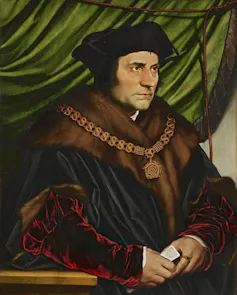
The lengthiest denunciation of Tyndale’s translation got here from More, the English humanist who was King Henry VIII’s leading political official.
In “A Dialogue Concerning Heresies,” More singled out three words that he believed rendered Tyndale’s translation heretical. Tyndale, he complained, used “senior” or “elder” as an alternative of “priest,” “congregation” as an alternative of “church,” and “love” as an alternative of “charity.”
Objectively, all of Tyndale’s selections are legitimate translations of the unique Greek. But using “elder,” More claimed, undermined the special status of priests within the Catholic Church. A “priest” had received the sacrament of holy orders, which, in response to Catholic teachings, set him other than the remainder of humanity.
The Frick Collection via Wikimedia Commons
Similarly, More argued that Tyndale’s use of “congregation” as an alternative of “church” was an assault on Catholicism. Protestants argued that the true church was not an earthly institution but the invisible community of all faithful Christians on Earth and in heaven. All that may very well be seen on Earth, they argued, were individual congregations. To More, this undermined the biblical origins of the Catholic Church.
Finally, Tyndale’s use of “love” as an alternative of “charity” reflected the Protestant concept that salvation was gained through faith alone, whereas Catholics taught that salvation also is dependent upon good deeds akin to charitable giving. Later, More called Tyndale a “hell-hound within the kennel of the devil.”
Bestseller through the centuries
Tyndale’s Bible went on to have an unlimited impact, on each Protestant Christianity and the English language.
His 1534 revision was heavily used – plagiarized can be a greater word – by just about all English translations over the subsequent hundred years. The 1539 “Great Bible,” which King Henry VIII ordered placed in all English churches, was heavily copied from Tyndale. Most strikingly, 83% of the New Testament within the famous King James Version, published within the early 1600s, was taken directly from Tyndale’s text.
Tyndale got here to a more unlucky end. In 1536, after 16 months in prison and interrogation by the Catholic Inquisition, he was executed for heresy in what’s now Belgium.
His pioneering translation work, nonetheless, set the stage for the Bible to change into the bestselling book of all time within the English language.
Source: https://theconversation.com/500-years-ago-the-first-new-testament-in-english-was-published-and-stirred-up-a-hornets-nest-282462


