



Almost every ceremonial object or ornament of the medieval papal monarchy has disappeared or lost its original purpose. Yet one survives: the golden rose.
On Sept. 26, 2026, during Pope Leo XIV’s visit to France, he traveled to Lourdes, home to considered one of the world’s most famous shrines to the Virgin Mary. After praying, Leo presented a golden rose to Our Lady of Lourdes – the fifth time he has dedicated a rose to a Marian shrine or image.
The ornate rose Leo offered to Lourdes just isn’t that different from its medieval iterations. The oldest surviving rose is now on the Musée de Cluny in Paris and dates from the early 1300s. Both are golden, with several branches and buds.
Yet who receives the roses, and why, has modified dramatically.
As a medieval historian researching the papacy, I ceaselessly find mentions of the roses. They are ubiquitous in medieval chronicles – most of all, in papal accounting registers. The history of the roses’ beneficiaries reflects the history of the papacy and the way its influence has shifted over the centuries.
Roots of tradition
Most medieval roses were product of gold and silver, adorned with precious stones corresponding to sapphires and rubies. One of the buds formed a small receptacle that held some musk and balsam, rare and expensive fragrances.
The Vatican Apostolic Archives have preserved the accounting registers that itemized most of the roses’ costs. On average, they weighed 11-16 ounces of precious metal and value the equivalent of 10 years of a laborer’s annual wage.
The golden rose first appeared through the papacy of Leo IX. On April 18, 1049, the pope exempted a nunnery in Alsace – now in Sainte-Croix-en-Plaine, France – from the legal authority and supervision of the local bishop. In return, the pinnacle of the nunnery was required to supply the pope a golden rose of some 2 ounces, or of equivalent value. At the time, roses were often used to symbolize a feudal pledge: the submission of a vassal to a lord.
Within a few generations, the gift had modified direction: The pope now granted a rose. The first clearly documented case took place in 1096, when Urban II, touring France and preaching the First Crusade, granted it to Fulk of Anjou to reward him for his willingness to participate.
Musée de Cluny via Wikimedia Commons
From the eleventh century on, the pope offered a rose yearly, on Laetare Sunday: the fourth Sunday of Lent, the period before Easter when many Catholics commit to some type of penance. According to ceremonial books called “ordines,” the pope held the rose through the worship service, preached about its symbolism, and presented it to a recipient.
On that Sunday, gifting the rose reminded believers that while Lent was difficult, beauty and joy would emerge from it. The day was also a feast in honor of the recipient – typically the prefect of Rome, who supervised town’s jurisdictions and police.
Diplomatic tool
Eventually, the choice about who should receive the glory rested solely with the pope. Still, it was at all times bestowed upon those that wielded power: the prefect of Rome, emperors, kings, military leaders and defenders of Christian lands. Receiving the rose was a public acknowledgment that the recipient – often a warrior – stood beside the pope in protecting the church.
In 1148, for instance, Pope Eugene III offered it to the king of Leon and Castile, Alfonso VII. A century later, Pope Innocent IV gave it to Raymond Berenger, count of Provence. In each cases the pope rewarded the fight against Muslims, whom the Vatican saw as “infidels” or heretics.
The Avignon papacy of the 14th century, a period when several popes resided in what’s now southern France, accelerated this evolution. Away from Rome, and within the absence of a Roman prefect, the rose’s role as a negotiating tool intensified.
By the 14th century, the ceremony had grown much more elaborate. According to ceremonial books, the pope carried the rose in procession, while its beneficiary held the reins of his horse and kissed the pope’s feet – a gesture of submission.
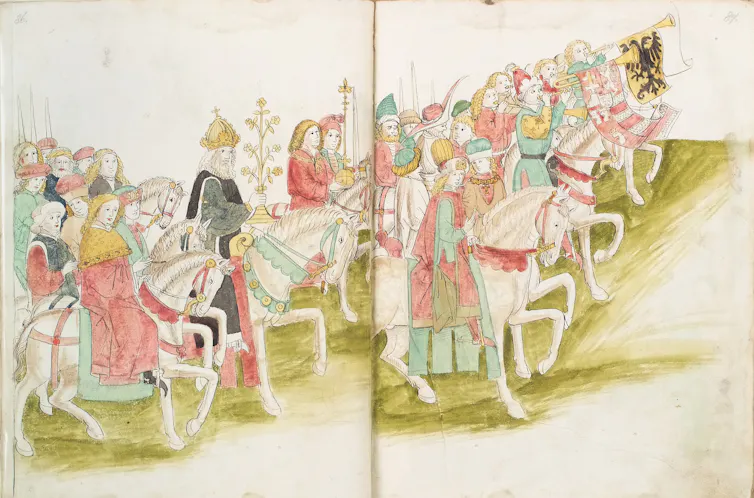
Chronik des Constanzer Concils by Ulrich von Richental/New York Public Library
Warriors, women – and shrines
Historians can estimate how many individuals received the rose based on evidence available within the Vatican’s accounting registers and other historical records. Over the years, an increasing number of began to be presented to women, after which to shrines. This change shows the history of the papacy – and of its communication strategy. Simply put, the evolution of the rose followed the evolution of papal power itself.
The first few centuries of the rose were a period of conquests and Catholic expansionism, when conversion often got here through war. With only a few exceptions, roses were offered to commend male medieval rulers, often ones who had militarily defended Catholicism.
The early modern period saw the birth of the Protestant Reformation and many non secular conflicts. Popes searched for support from the era’s powerful women rulers, corresponding to Catherine de’ Medici, who played a vital role during France’s wars of faith between Protestants and Catholics. From the sixteenth century onward, roses were often given to women like her: empresses, queens and the wives of high dignitaries.
That shift accelerated within the 18th and nineteenth centuries, when most roses were gifted to Catholic women of high standing. From 1790 to 1893 not a single man received the rose.
This was a period of revolutions and secularization, when the church couldn’t rely on the military leadership of a king, duke or the nobility. Again, queens and empresses dominated the beneficiaries. With the rose, popes could flatter and honor the wives of vital rulers, who in turn could pressure their spouses if needed. Eugénie, empress of the French and wife of Napoleon III, received it in 1856 for her piety and philanthropy.

Library of Congress via Wikimedia Commons
The twentieth and twenty first centuries saw a complete abandonment of gifting the rose to humans. Instead, popes have presented them to shrines and basilicas, typically ones dedicated to the Virgin Mary. The last person given a rose was Charlotte, grand duchess of Luxembourg, who received one in 1956 for her piety and courage during World War II.
1,000 years of change
Today, Leo XIV continues the tradition. Devotion to Mary stays central to Catholic identity in an age when political authority now not carries the identical religious weight. Gifting the roses to holy shrines, images or basilicas separates them from any suggestion of political and spiritual alliance or favoritism.
The history of the golden rose reveals the shift of papal priorities from political alliance-building to devotional symbolism. What was once a diplomatic gift addressed to earthly power is now offered to Marian shrines: the roses embody faith itself. The recipients modified since the church’s relationship to power modified.
I see the rose as an ideal example of the Catholic Church’s deep understanding and adaptation to its time and its gift for reinvention. Few institutions have managed to maintain a medieval ceremony alive for nearly a millennium while completely transforming its meaning. The golden rose is the papacy’s oldest public relations tool.
Source: https://theconversation.com/what-1-000-years-of-golden-roses-tell-us-about-popes-authority-and-influence-from-leo-ix-to-leo-xiv-293311


